

If you’ve ever watched America’s most-watched annual football championship game, you know it is far more than a sporting event. It has become a cultural moment, a benchmark for live media performance, and one of the most concentrated advertising opportunities of the year.
For brands able to secure airtime, it represents a high-stakes environment where visibility, emotion, engagement and performance converge. For the streaming industry, it serves as a stress test, revealing how well large-scale live distribution and monetization systems truly perform under extreme audience pressure.
This article examines publicly reported data from recent editions of the Super Bowl[1] to understand what they reveal about the evolution of streaming and ad delivery.
Record-Scale Streaming and Viewership
According to Nielsen (1), an estimated 124.9 million viewers watched the 2026 championship game on Sunday, February 8, making it the second-largest audience in U.S. history across television and streaming platforms.
Although slightly lower than last year’s record of 127.7 million U.S. (2) viewers, it is still a massive audience making it a unique opportunity for the advertisers able to leverage this nationwide gathering.
This year, it was televised on NBC, NBC Sports Digital, NFL+ and streamed on Peacock (also YouTube TV, DirecTV+, Sling TV), with Spanish-language coverage on Telemundo and Universo.
According to Dan Rayburn (3) , its viewership has increased year after year, as shown in the chart below.
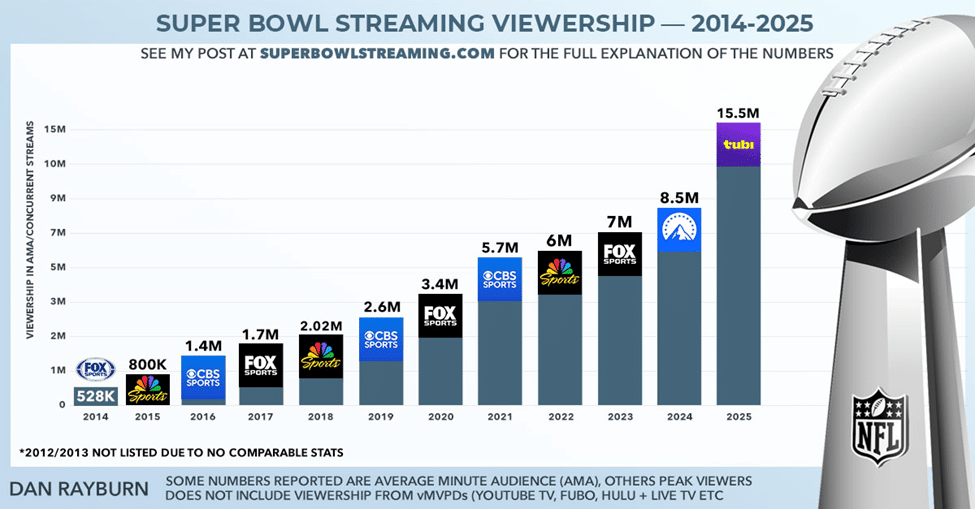
(3) Source: streamingmediablog.com © 2025 streamingmediablog.com. Available at : Super Bowl Streaming Viewership Numbers From 2014-2025 – Dan Rayburn – StreamingMediaBlog.com
Halftime Performance and Advertising as Cultural Events
It is no surprise that the audience peaks during the half-time show. Over the years, the half-time performance has become a cultural event in its own right, drawing global music stars and huge live viewership.
In 2025, the halftime show marked a high point (4), with Kendrick Lamar’s performance drawing more than 133.5 million TV viewers, the largest half-time audience on record.
In 2026, Bad Bunny’s halftime show averaged 128.2 million viewers, still higher than the game overall. This year the peak was during the second quarter of the game (7:45 p.m. to 8 p.m. ET) with NBC reporting an average of 137.8 million viewers, the highest peak viewership in U.S. TV history.’(5)
Commercial pricing reflects this extraordinary concentration of attention. In 1968, TIME magazine reported that one minute of advertising during the broadcast sold for a then unprecedented US $150,000 (6). By 2024, according to Ad Age (7), the cost of a 30-second placement had reached approximately $7 million, with estimates for 2026 approaching $8 million.
Over time, advertising during the championship game has evolved from straightforward product promotion into cinematic storytelling and integrated omnichannel campaigns. The event now serves as a launchpad for brand initiatives that extend well beyond the broadcast itself.
Live Sports Streaming as an Industry Stress Test
The 2026 Super Bowl once again served as a large-scale performance benchmark for live streaming infrastructure.
Industry analyst Dan Rayburn (3) conducted real-time monitoring of NBC’s Peacock stream during the event, testing more than 25 devices and platforms side by side while tracking ISP performance data and social media feedback throughout the broadcast.
According to his published observations, the Peacock stream delivered consistently strong video quality across major connected TV environments, including Fire TV, Roku, Apple TV, and iOS devices. Rebuffering incidents were reported as minimal, and there were no signs of systemic outages despite exceptionally high concurrent audience levels.
NBC was simultaneously managing coverage of the Winter Olympics during the same period, making the technical achievement even more notable from an operational standpoint. There were minor social media complaints, but no evidence of widespread failure.
Taken together, the publicly reported data suggests that large-scale streaming platforms are increasingly capable of supporting extremely high live concurrency loads during premium sports broadcasts.
However, stable video delivery alone is not sufficient. Monetization systems must perform with equal reliability under the same pressure.
New Ad Model: Why Streaming Must Get the Ad Experience Right
As Paolo Pescatore commented (8), the big game has become a single-day benchmark not just for connectivity, but for how attention is monetized at scale. Beyond network performance, it highlights a broader shift toward owning the fan experience and turning peak moments into premium commercial opportunities. Advertising, sponsorships and new forms of access are increasingly used to test whether live events can support higher-value, real-time and experience-driven monetization models.
Turning peak attention into revenue depends on whether ads can be delivered cleanly, consistently and at scale. That’s where the challenge begins for streaming and ad tech platforms.
Ad delivery in streaming is more complex than in broadcast TV. It happens in real time, so during important sports events championships that attract millions of viewers at once, even small issues can disrupt ads and immediately affect revenue. It can be challenge,ut as viewership continues to shift toward streaming, platforms can’t afford to miss the opportunity to monetize those moments.
Ad Age (7) highlights how advertising during the American’s biggest game changed, and what that means for streaming and ad delivery. Ads are now part of full omnichannel campaigns, not isolated TV moments. Brands activate their campaigns across linear broadcast, streaming platforms, social networks and interactive ad formats before, during and after the game to maximize impact.
As a result, ad performance is no longer measured only by viewership or impressions. Advertisers now track engagement, sharing and social buzz, alongside direct actions enabled by interactive formats such as QR codes and clickable ads.
These signals reflect a broader shift from traditional audience measurement to engagement-based metrics that better match how viewers consume and respond to ads today.
Enabling Reliable Ad Insertion at Scale for Live Sports Streaming
The event provides a valuable benchmark for how streaming platforms must prepare for peak-scale live audiences. And while broadpeak.io is not involved in the distribution of the Super Bowl itself, the SaaS platform has extensive experience supporting large-scale international live sporting events.
Delivering ads at that level of attention requires more than inserting a few mid-rolls. It requires ad technology that can operate reliably in real time, support new formats, and adapt to how viewers actually watch.
This is broadpeak.io’s domain. Built around Server-Side Ad Insertion (SSAI), the platform allows ads to be inserted dynamically into live streams while preserving a broadcast-like experience across devices. That foundation is critical during sports events where millions of viewers join, leave or switch screens at the same time.
As for scalability, the platform offers native auto-scaling to swiftly adapt to audience variations in real time. For exceptional events like premium live sports, a warm up trigger can also be applied to ensure pre-scaling is done with the required level of session concurrency ahead of very sudden traffic spikes.

With broadpeak.io, ads can be contextualized and personalized at the session level, enabling formats that go beyond traditional video spots. Interactive solutions such as Click2® add a performance layer, letting viewers engage with ads directly from the TV screen using a companion device, without interrupting the live stream. Fans can order what’s on screen with a simple click, no need to pause or stop the game.
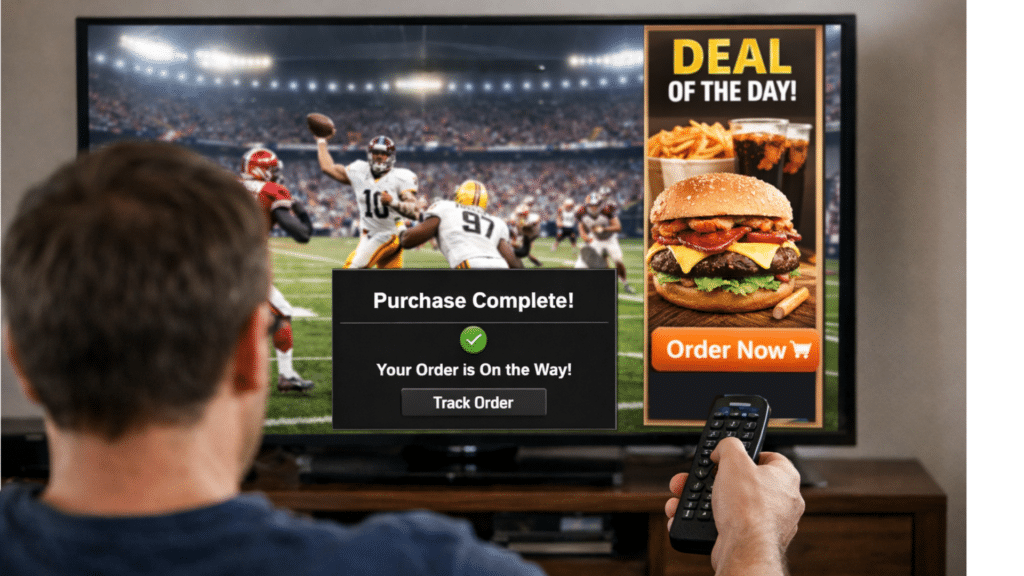
broadpeak.io also supports non-intrusive formats like L-Banners (part of the layout template included in the BannersIn2 ad unit portfolio), which create additional inventory alongside live content rather than replacing it.
Built on industry standards such as IAB SIMID, these formats work across CTV environments and integrate with existing ad servers and programmatic platforms, making them easier to deploy at scale. For fans, these agentic L-Banners enable lightweight interaction, such as exploring an offer or initiating a purchase, without interrupting or replacing the live viewing experience.
All of this is backed by real-time analytics, giving streaming services visibility into ad delivery and engagement as the event unfolds. During high-value moments, that insight is essential to ensure campaigns are delivered as intended and monetization stays aligned with audience behavior.
Taken together, this approach allows streaming services to move from simply handling peak traffic to fully monetizing peak attention, turning premium live sports moments into predictable, scalable advertising opportunities.
Broadpeak works with operators and video streaming services to assess ad workflows, support new formats and ensure monetization scales reliably during high-value live events.
Third Party content:
(1) Super Bowl LX Delivers 124.9 Million Viewers | Nielsen. Source: Nielsen web site | © 2026 Nielsen
(2) Super Bowl LIX averages record audience of 127.7 million viewers. Source: NFL | © 2025 NFL
(3) Super Bowl Streaming Viewership Numbers From 2014-2025 – Dan Rayburn – StreamingMediaBlog.com. Source: Dan Rayburn | © 2025 streamingmediablog.com
(4) Super Bowl LIX halftime show. Source: Wikipedia | © 2026 Wikipedia
(5) Super Bowl 2026 Hits 124.9 Million Viewers, Down 2.8 Million From Last Year. Source : Variety | © 2026 Variety
(6) 10 Memorable Super Bowl Commercials. Source : Forbes | © 2025 Forbes
(7) The top 5 Super Bowl social media moments to know about.Source: AdAge | © 2024 AdAge
(8) Super Bowl LX: Telecoms Showcase Connectivity, Innovation | Paolo Pescatore a publié du contenu sur ce sujet | LinkedIn. Source: LinkedIn | © 2026 Paolo Pescatore
[1] “Super Bowl” is a registered trademark of the National Football League. This article is provided for informational purposes only and is not affiliated with, endorsed by, or sponsored by the NFL.
Our blog page may reference third-party companies, products, events, articles, or services for editorial and information purposes.
The referenced event and related media are presented for informational and editorial purposes only. All trademarks, logos, and brand names are the property of their respective owners. Such references in our blogs are for information and editorial purposes only
This shall in no event and shall not be deemed to imply any affiliation, sponsorship, or endorsement unless explicitly stated.
Our analysis and discussion of our solutions in this context are independent commentary and do not imply any commercial relationship with such mentioned third party organizations, products or events.