

Moving into a streaming-only distribution era.
For Content Providers, CDN as a service is an essential part of the video delivery chain. As viewers, our UX is always directly impacted by CDNaaS performances regardless of the devices we use (CTV, STB, mobile devices) to watch content.
OTT delivery through CDN as a Service has become the de facto mean for any content owner wishing to distribute video media to large audiences. Broadcasters, studios, sports leagues, aggregators and other content rights holders all have a common need. Whether streaming VoD, linear, time shifted TV, premium live sport events or FAST, whether streaming in SD, HD or UHD 4K HDR formats, a CDNaaS must consistently bring content, in DASH and HLS formats, to millions of end users, with the highest QoE.
With the end of terrestrial broadcast approaching in multiple countries, streaming will soon become the sole distribution mean to audiences. From such a standpoint, all CDN as a Service offerings are getting under tight scrutiny to ensure extremely reliable traffic delivery on a nationwide scale.
Guaranteed bandwidth as a service: moving from GB to Gbps/h delivery contracts
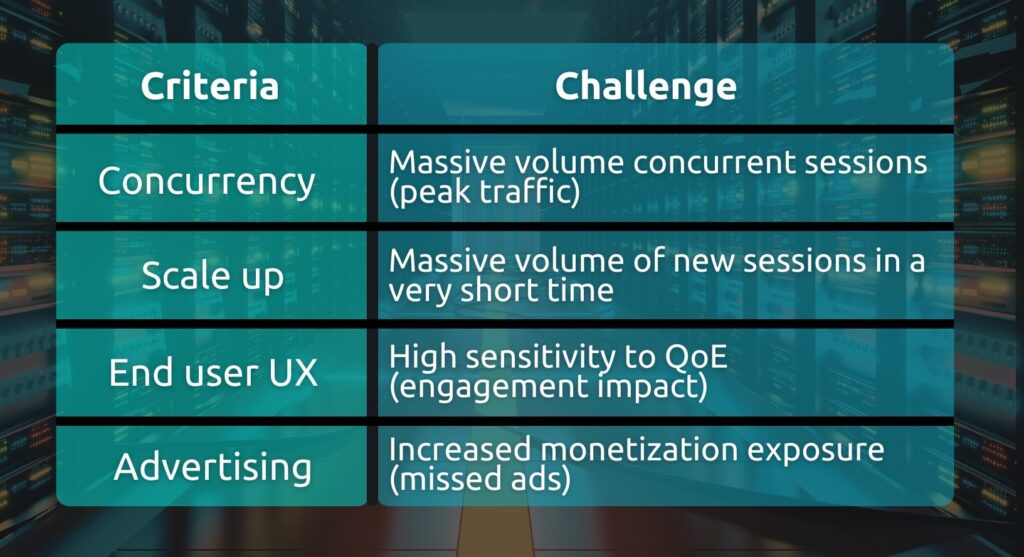
While standard streaming workflows are typically managed as “business as usual”, premium live sports, prime time and special live events such as elections are in a different category. Altogether, they form one of the most challenging use cases in the sense that they generally come with the following set of requirements:
If we step back and look at the highest audience events – see it at “A List of the Largest Live Streaming Events in History and How They Are Measured” (1), few exclusive sports events set the bar at an exceptionally high level:
The Jake Paul vs. Mike Tyson boxing match on Netflix attracted 65 million viewers in November 2024 for an estimated total bandwidth of 65 Tbps.
On a similar scale, the Champions Trophy Final (cricket) on JioHotstar gathered 60 million viewers in March 2025 topping a whopping 60 Tbps aggregate bandwidth (learn more with this interview: Streaming cricket at massive scale: lessons from JioStar’s CTO)
While streaming events only map to a fraction of those record-breaking capacity numbers in most markets, streaming as a service remains a best-effort delivery mean by default.
In general, and despite massive global scale, CDN as a Service providers such as Akamaï, CloudFront, Fastly, CloudFlare or other public cloud services providers face similar constraints.
Consequently, content providers are often limited to putting together a combination of services and workarounds to minimize risk during most critical time, including means such as:
- custom SLA
- capacity allotment (maximum guaranteed available throughput)
- multi CDN delivery
- over provisioning
- special care and custom services
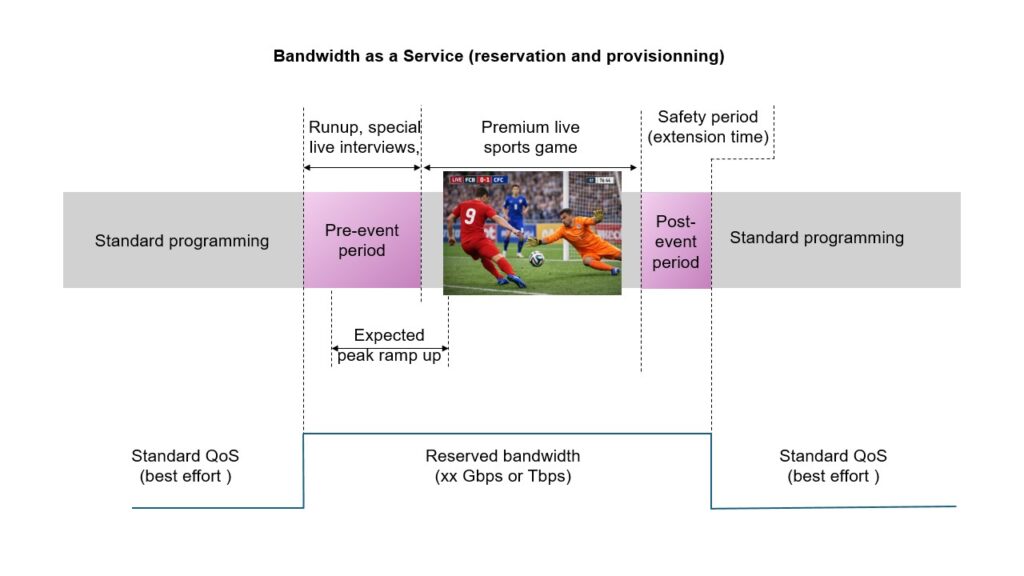
Going from a best effort approach to a piece of mind approach can be efficiently solved by a unique and unfound CDNaaS feature: bandwidth on demand with streaming delivery capacity reservation at the edge.
This kind of capability basically ensures that, on a given geography or market, at a specific time, and for specific devices, delivery capacity is going to be available to align with concurrency projections and to meet the most demanding QoE expectations.
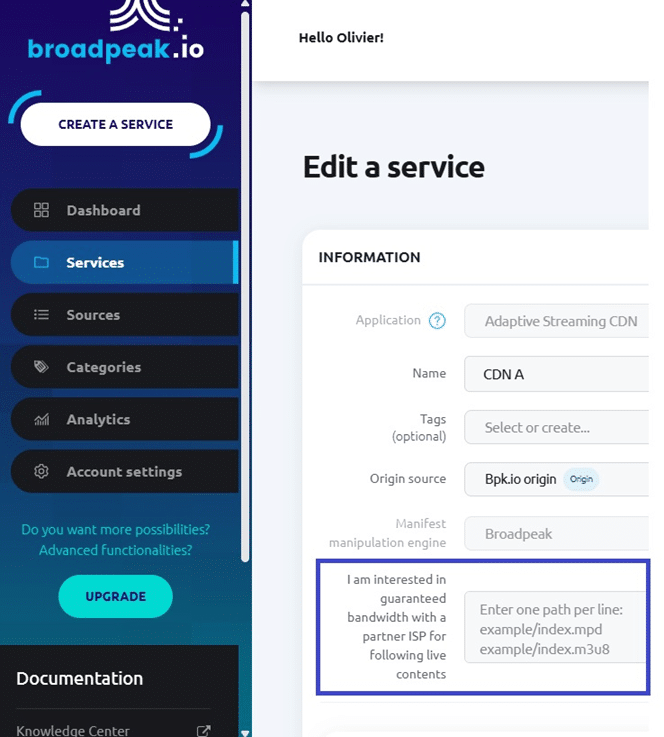
Bandwidth as a Service example (reservation and provisioning)
The game changing criteria: bypassing peering with on-net caching at the edge
Today, as most CDN as a Service providers host their caching infrastructure at peering points with operators and ISP (Internet Service Providers), video streaming traffic is subject to an extensive set of uncontrolled constraints including but not limited to packet loss, jitter, latency, and buffering. This situation typically results from peering points lacking capacity for massive video volumes, often causing cascading failures.
Indeed, peering contracts typically include the following topics:
- relationship type (typically symmetrical)
- joint traffic routing policies (usually via BGP)
- commercials (settlement-free or paid)
- interconnection points (location, network ports, capacity)
- parties and scope (AS identification)
- operations & SLA
However, peering contracts do not include “reserved” capacity for specific traffic like streaming video, as they emphasize settlement-free exchange without strict SLAs or commitments. Instead, committed capacity for video traffic is achieved through paid peering (where one side pays for guaranteed bandwidth) or dedicated capacity products layered onto peering arrangements.
Still, peering agreements do not provide application-layer specific capacity reservations, as they operate at the IP/routing layer without visibility or control over protocols, ports, or higher-layer flows like video streaming.
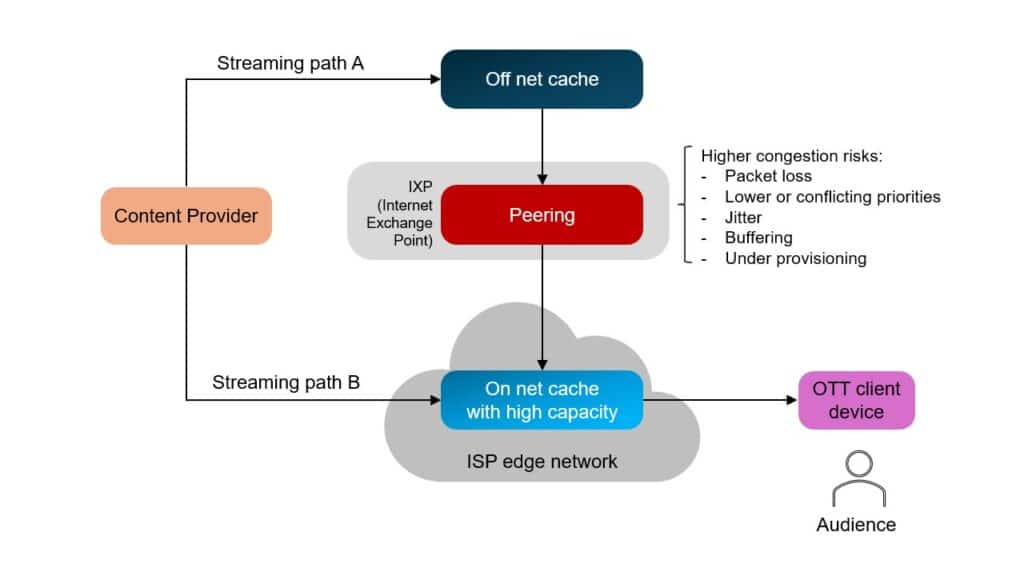
This is essentially why combining on-net hosting directly and high streaming caching capacity inside the ISP network is the key for boosting delivery performance. As the aggregated IP traffic exchange point is bypassed, video delivery capacity and QoE is far more sustained and controlled. Delivery is becoming a native part of the ISP network infrastructure as it is directly hosted at the network edge.
Of course, this ability requires massive efforts: negotiations, hosting high performance caching software and infrastructure directly at the network edge, compliance with the highest security standards, global footprint presence, etc… Doing this with hundreds of operators and ISPs is a long and tedious process. This is essentially why “bandwidth as a service” is one of the biggest added-value CDNaaS can offer to demanding Content Providers.
Conclusion
Content Providers need to consider a wide range of criteria and KPIs for selecting the most appropriate CDNaaS. Tens of streaming delivery services are available on the market, and they each come with their own offerings: price (volume delivery per GB or TB), QoE (latency, TTFB, startup time, buffering, …), accessibility (public, private), resiliency (availability, uptime, …), market coverage (region, PoP), security, sustainability. Those variables are some of the many metrics and key parameters to watch out for.
Today, however, we see a new disruptive metric emerging in a new generation of CDNaaS: guaranteed bandwidth over a period of time (e.g. xx Gbps during yy hours). As traffic and QoE expectations grow, this kind of capability is likely going to become a discriminating factor to select a highly reliable delivery service.
Unlike most data CDNaaS, broadpeak.io’s ASCDN is specifically optimized for video streaming delivery. By leveraging a combination of StandardPoP and HyperPoP streaming caches (see Press Release for more details), this service provides global video delivery, and, in some markets, guaranteed bandwidth reservation with on-net edge delivery. This reservation feature, which is running on HyperPoP technology, typically allows a Content Provider with live content to book and provision a given capacity during prime time or during a premium live event.
Let’s take an example and let’s assume a Broadcaster or a sports content owner wants to maximize the QoE of a 90-minute football game delivered to an audience of half a million end-users. If we assume that the QoE will consume an average of 6 Mbps per session, the ASCDN service would typically be provisioned for a 3 Tbps video delivery window for 2 hours on a given network footprint. Having the reservation acknowledgment ahead of time gives a high level of confidence to ensure that the service is pre-configured but also to ensure that the capacity is available and committed for this specific event
If you want to know more about such capabilities and test them on the broadpeak.io platform, you can either sign up or reach out to us (email).
Note: our blog may reference third-party companies, products, events, or services for editorial purposes. The referenced event and related media are presented for informational and editorial purposes only. All trademarks, logos, and brand names are the property of their respective owners. Such references in our blogs are for information and editorial purposes only. This shall in no event and shall not be deemed to imply any affiliation, sponsorship, or endorsement unless explicitly stated. Our analysis and discussion of our solutions in this context are independent commentary and do not imply any commercial relationship with such mentioned third party organizations, products or events.
Third-party content:
(1) A List of the Largest Live Streaming Events in History and How They Are Measured. Source: Dan Rayburn | © Dan Rayburn 2026.