
The new kid on the block
Monetization is becoming a de facto business model for a wide range of streaming services providers. At the core of the Ad Tech stack lies the ad insertion component. This engine can be entirely located on the backend (Server Side), on the consumer end (Client Side) or distributed across both ends (Server Guided). Each approach has constraints and benefits, some of which might be relevant to your specific ecosystem and strategy. In this blog, we’ll have a closer look at the latter one. Server Guided Ad Insertion (aka SGAI) is a rather new technology which has been designed to solve real operational, monetization and scalability challenges.
High level principle and comparison
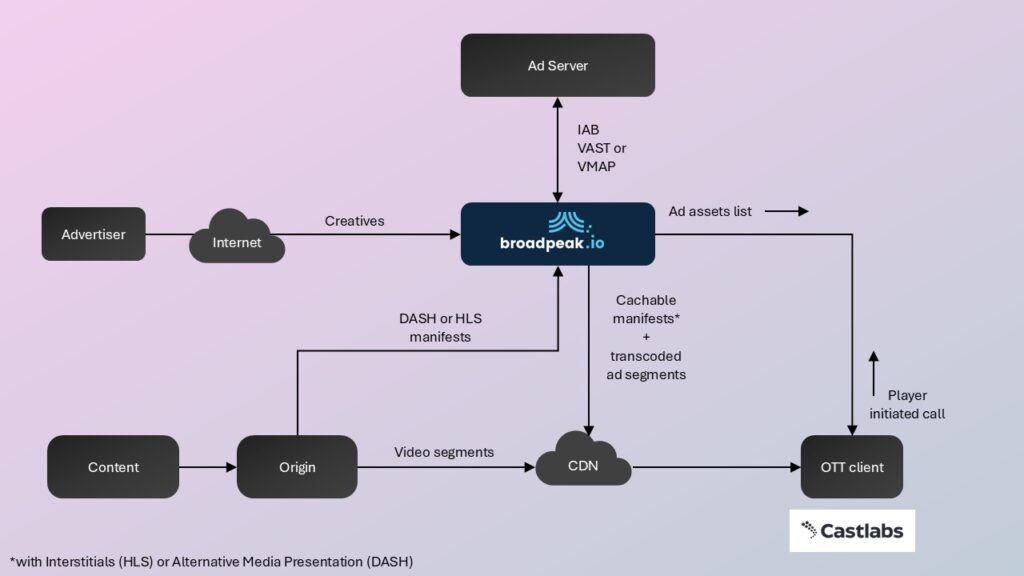
If we focus on server side and server guided schemes, both SSAI and SGAI are manifest proxies which end-user clients read DAHS or HLS manifests from. However, there is a fundamental difference in the way manifests are processed by those two schemes.
SSAI
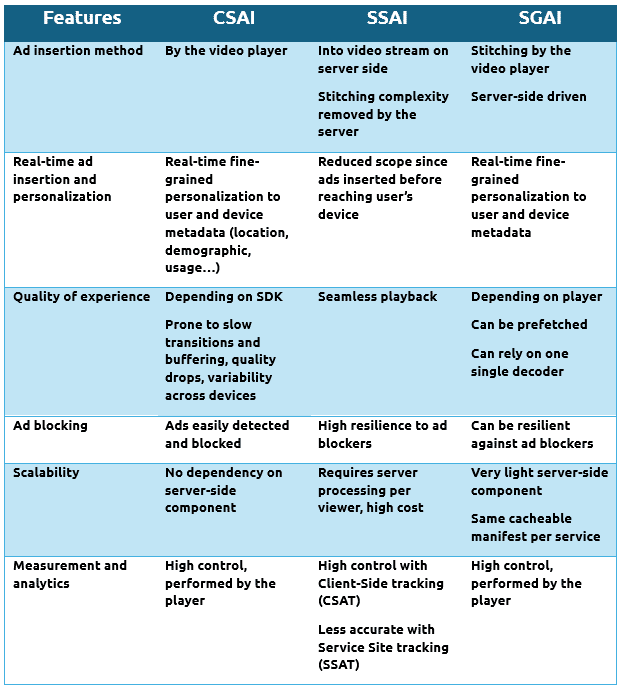
In SSAI, manifests reference content segments (including ad segments). It means that they are unique to each user. They are individually streamed to each client with the actual reference to content and the personalized sequence of ad video segments.
The call to the ad server is made by the SSAI (typically when detecting SCTE-35 cue out markers for live mid roll ad replacement or at session start for AVOD)
In addition, markers such as SCTE-35 cue out and cue in triggers are typically removed by the SSAI. This filtering is making the solution highly resilient against ad blockers as there is no ad break signaling exposure.
For live workflows, it requires the backend platform to scale up to massive cluster sizes very rapidly. This capability can be a challenge for premium live events streamed to very large audiences (millions of end users). For VOD workflows, it requires all ad breaks to be filled at session start which might translate into low sell-through rates (STR) as viewer might not consume the VOD asset entirely
SGAI
In SGAI, manipulation consists of modifying the manifests without processing the content itself (segments).
The proxy, in this case, marks and signals ad breaks in the manifest without making a call to the ad server. As the call to the ad server (whether VAST or VMAP) is initiated by the player, certain use cases can benefit from dynamic workflows with just in time ad resolution. As illustrated in the diagram below, the player has better control as it can now decide which specific ad opportunities signaled in the manifest it actually requires the ad resolution for.
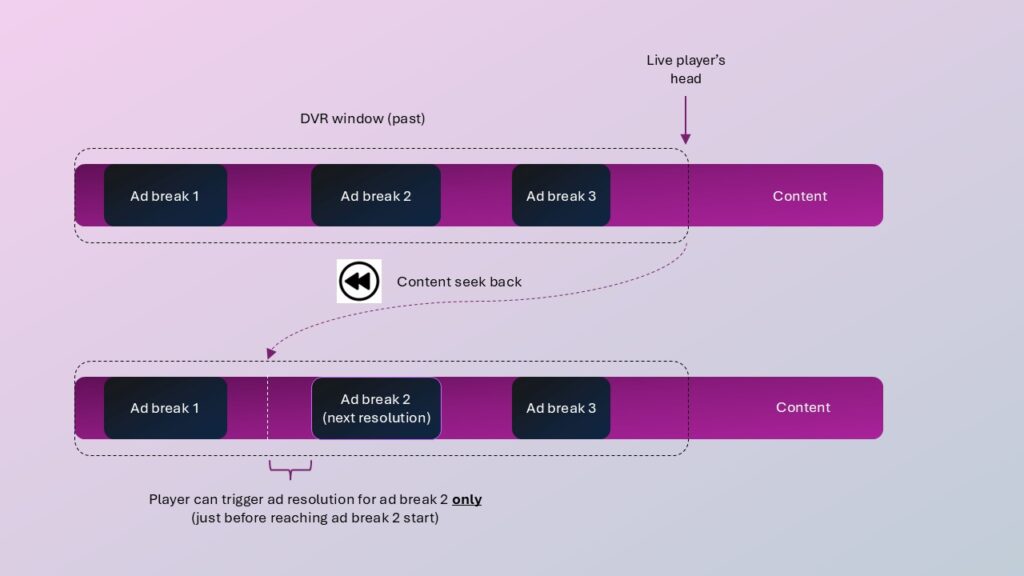
Unless content personalization is applied, it also means that manifests are common for all end users and therefore cacheable as the ad personalization is not applied yet at that stage. This feature is one of the biggest benefits of SGAI over SSAI when dealing with large scale live streaming such as premium live sports events.
However, signaling in the manifest (HLS Interstitials [i] or DASH Alternative Media Presentation [ii]) is necessary for the player. Ad blocking can be made resilient even if it is not as natively efficient as in SSAI.
Comparing options
Use cases examples
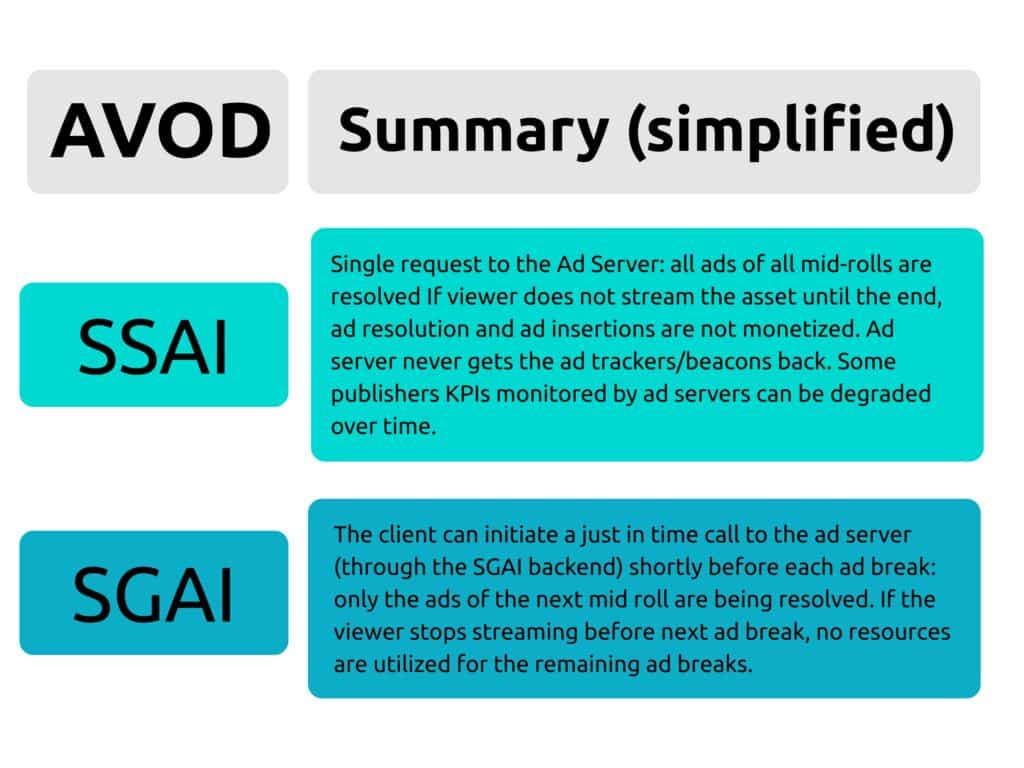
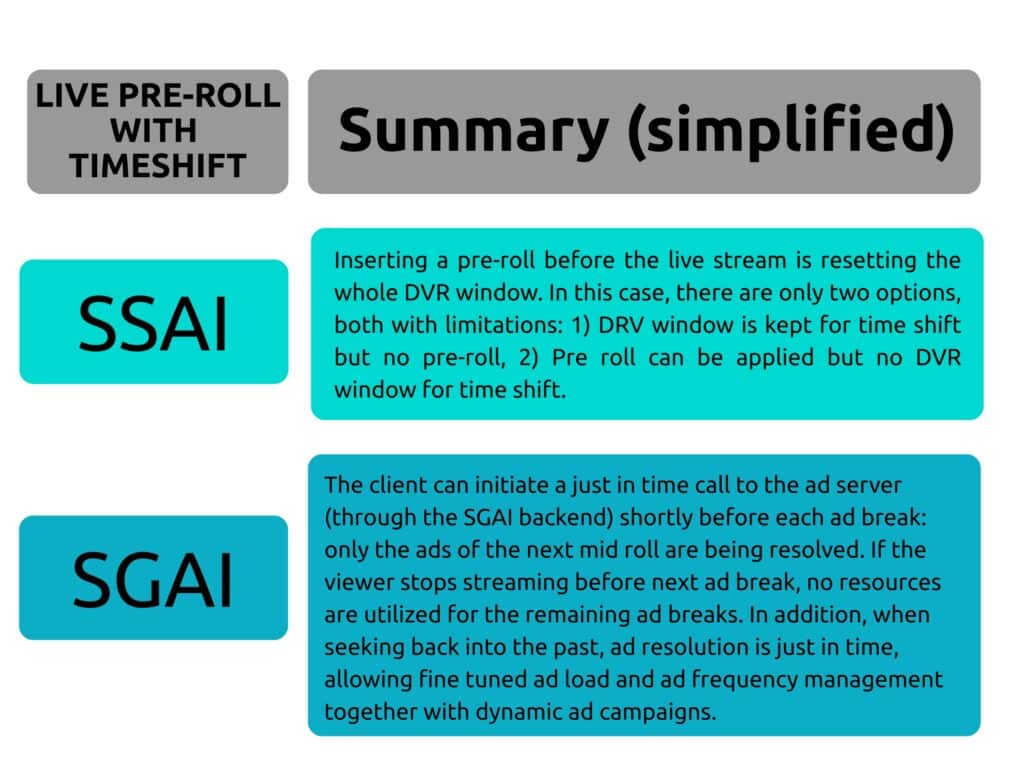
The benefits of “just in time”.
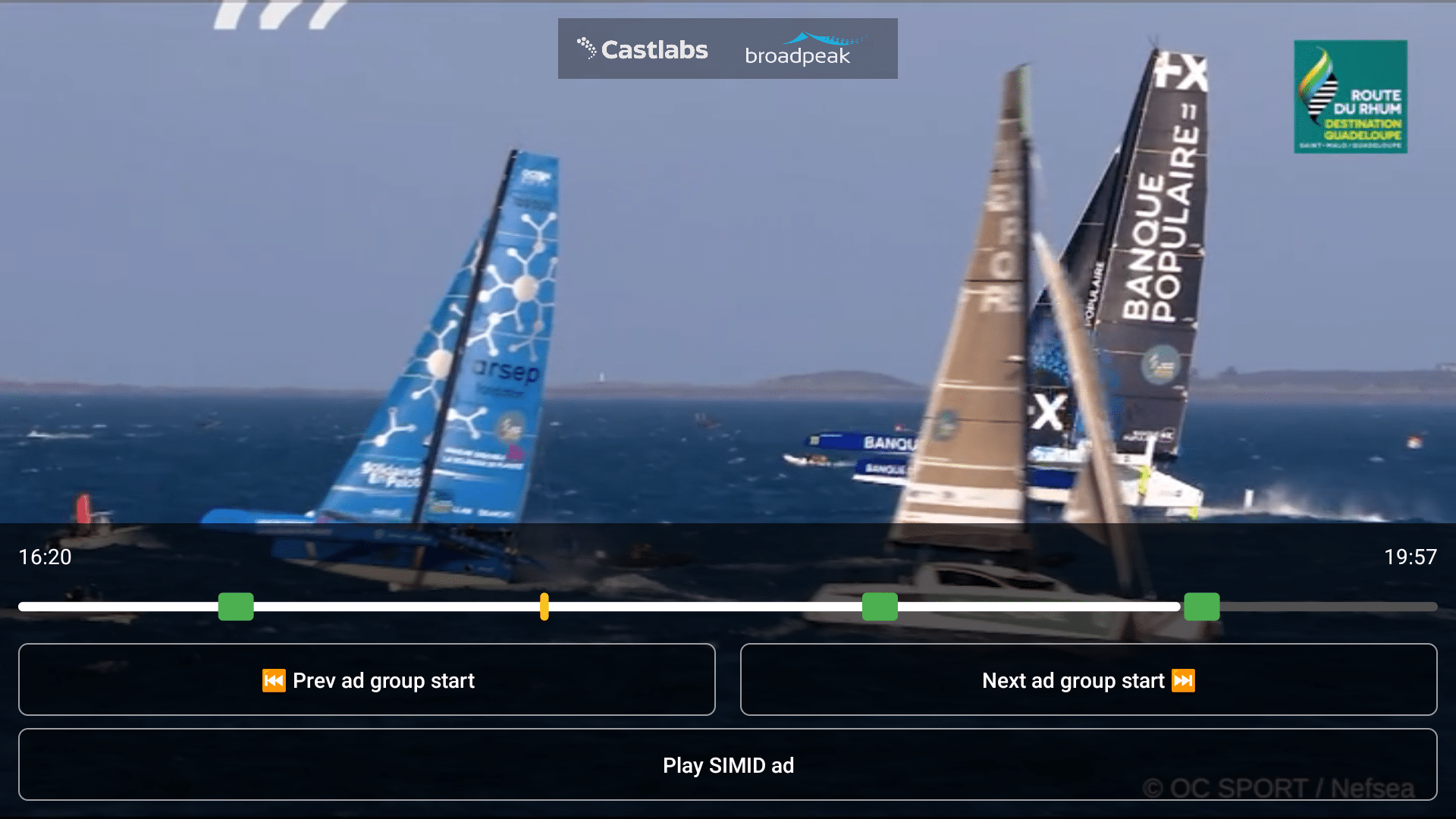
One of the most interesting aspects of SGAI is to enable “just in time” ad resolution. This capability applies to closed manifests assets (e.g. VoD, cPVR) as well as time shifted workflows for instance.
In the following example, only the next break being monetized in the forthcoming seconds is being processed (segments highlighted in green). The other segments are simply signaled but not “consumed” (yellow marks on the timeline).

Addressing new CTV ad formats with SGAI
Traditional ad inventory is still almost exclusively based on pre-rolls and mid-rolls. Today, video ads are still representing the bulk of any ad revenue stream on CTV.
Although not deployed in many markets yet, innovative formats are emerging. Instream ad units (e.g. L-banner, skyscraper, arch, etc….) as well as interactive formats (e.g. shoppable) become real inventory options. Such formats preserve the viewer’s engagement with the content while allowing advertisers to deliver their message in a less intrusive manner. They are related to what IAB has defined as CTV Ad Portfolio and Guidance [iii] for core CTV ad formats. Those new layouts include Pause, Screensaver, In Scene, Content Squeeze backs, Ad Squeeze backs, Overlays, and Immersive / Extendable with user interaction. Although many approaches can be considered, IAB SIMID clearly stands out as an obvious implementation choice. This framework can be considered as an efficient means to enable new CTV ad formats on SGAI architecture.
The reason why new CTV ad formats are getting increasing traction is clear: on the business side, they are becoming real opportunities to access new types of demand and to increase fill rates.
The following two UX examples demonstrate how non-linear SIMID creatives can be combined with an Ad Tech stack powered by SGAI. This solution is powered by broadpeak.io BannersIn2 and Castlabs’ PRESTOplay playback technology.

Before choosing: considering discernment and nuance
With CSAI, SSAI and now SGAI, streaming service providers have a new choice to consider for their Ad Tech stack. While SSAI is mature and deployed at scale across all markets, SGAI – apart from a few major streamers – is still in its infancy from a commercial deployment track record point of view. As seen above, SGAI is clearly scoring points for specific use cases which are solved in a very efficient way. One may ask a legitimate question as to what path to consider when moving to ad-based model or when optimizing existing monetization ecosystems. Having the answers to certain questions can help Publishers qualify their own needs and adequation with the SGAI stack. For instance:
- What is my monetization strategy?
- What type of inventories do I want to sell?
- How am I going to sell my inventory?
- Do I need to support very large scale audiences for live ad replacement? (millions of concurrent sessions)
- Do I really need to optimize and finetune my stack at this stage of the project?
- Do I need pre-roll for live and monetization of past breaks with time shift?
All in all, one can also foresee hybrid deployments with a mix of SSAI and SGAI. This scenario is relevant for content providers facing operational constraints such as device fragmentation. It would effectively mean operating both schemes in parallel during a transition period until complete deployment of the SGAI workflow across all devices. For Operators, this scenario is less relevant as they typically manage a more consistent set of client devices such as STBs with a unique player.
Take away: why Broadpeak and Castlabs?
Delivering SGAI successfully requires tight integration between delivery infrastructure and playback technology. Broadpeak enables scalable, efficient content delivery and manifest manipulation at the network level. Castlabs provides secure, high-performance playback with advanced ad execution, and support for next-generation formats. Together, this combined Ad Tech and playback solution enable end-to-end SGAI workflows – from signaling ad opportunities to executing and measuring them in real time.
At IBC 2026, Broadpeak and Castlabs are showcasing an SGAI implementation. Multiple use cases are demonstrated, including BannersIn2 instream ads powered by an IAB SIMID stack. Visit Broadpeak’s booth at #1.F83 or Castlabs’ booth at #5.F26 to explore how SGAI can future-proof your monetization strategy.
Thirty Party Content
[i] Getting Started with HLS Interstitials 1.0b3 | © Apple 2021
[ii] DASH-IF implementation guidelines: restricted timing model | © DASH IF 2024
[iii] CTV Ad Portfolio | IAB Tech Lab | © IAB Tech Lab 2026