
The creator economy is no longer a niche segment of social media. It is becoming a major force in global media and entertainment.
What started with individual creators publishing videos on platforms like YouTube has evolved into a broader media ecosystem that now spans podcasts, streaming apps, FAST channels, connected TV, and even large-scale entertainment productions. Creators are no longer simply influencers building audiences on social platforms. Many are becoming fully fledged media businesses with global distribution strategies, production teams, merchandising operations, and increasingly sophisticated monetization needs.
According to the Goldman Sachs Research [1], the creator economy could approach half a trillion dollars by 2027, with more than 50 million creators worldwide participating in the ecosystem.
As audiences continue shifting toward creator-led content, the industry is entering a new phase: professionalization. And with that shift comes a critical challenge.
Monetization infrastructure must catch up.
The Creator Economy Is Becoming a Media Powerhouse
For years, traditional broadcasters, studios, and streaming services dominated audience attention. Today, creators increasingly compete in the same entertainment economy.
Media analyst Evan Shapiro [2], has frequently described the modern media landscape as an ecosystem where creator-led brands now sit alongside broadcasters and streaming giants. The distinction between “creator” and “media company” is becoming increasingly blurred.
This transformation is visible across the industry.
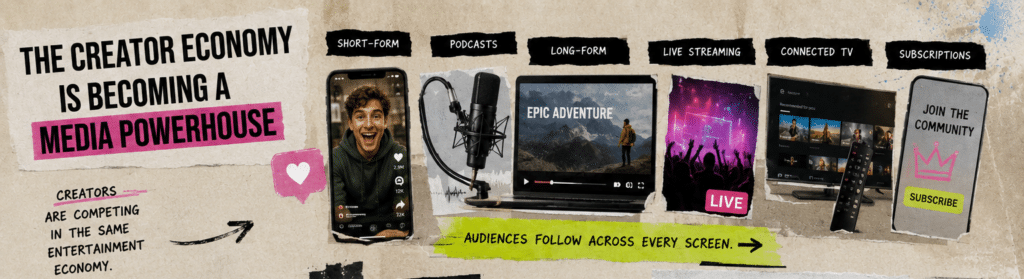
Creators are expanding beyond short-form social video into podcasts, long-form content, live streaming, connected TV, and subscription platforms. Their audiences are following them across every screen.
In many cases, creator-led content now rivals traditional television in both engagement and reach.
The evolution is particularly visible on YouTube, which has become one of the largest video distribution environments in the world. Large creators now operate global entertainment brands capable of generating viewership at a scale once associated only with broadcasters and major streaming platforms.
When Creators Become Media Companies
Few examples illustrate this shift better than Mr.Beast [3]
MrBeast’s main YouTube channel now exceeds 480 million subscribers and generates billions of views every month. His productions involve large teams, professional sets, complex sponsorship operations, merchandising businesses, and multi-platform distribution strategies.
This is no longer the profile of an independent creator working from a bedroom studio.
It resembles a modern media company.
And MrBeast is not an isolated case.
Across the creator economy, major creators are building production studios, launching brands, developing direct-to-consumer platforms, and expanding into streaming ecosystems previously dominated by broadcasters and OTT services.
Some creators are also entering the FAST ecosystem and connected TV distribution, bringing creator-led content into environments traditionally associated with professional television distribution.
At this scale, creators face many of the same business challenges as traditional media organizations:
- How do you monetize audiences across multiple platforms?
- How do you scale advertising operations efficiently?
- How do you deliver targeted advertising experiences?
- How do you maintain monetization consistency across streaming environments?
The challenge of monetization is becoming increasingly strategic.
Monetization Is the Next Frontier for Creator-Led Media
The first generation of creator monetization relied heavily on platform revenue-sharing models, sponsorships, and branded content.
Those models remain important, but they will no longer be sufficient for creators operating on a media-company scale.
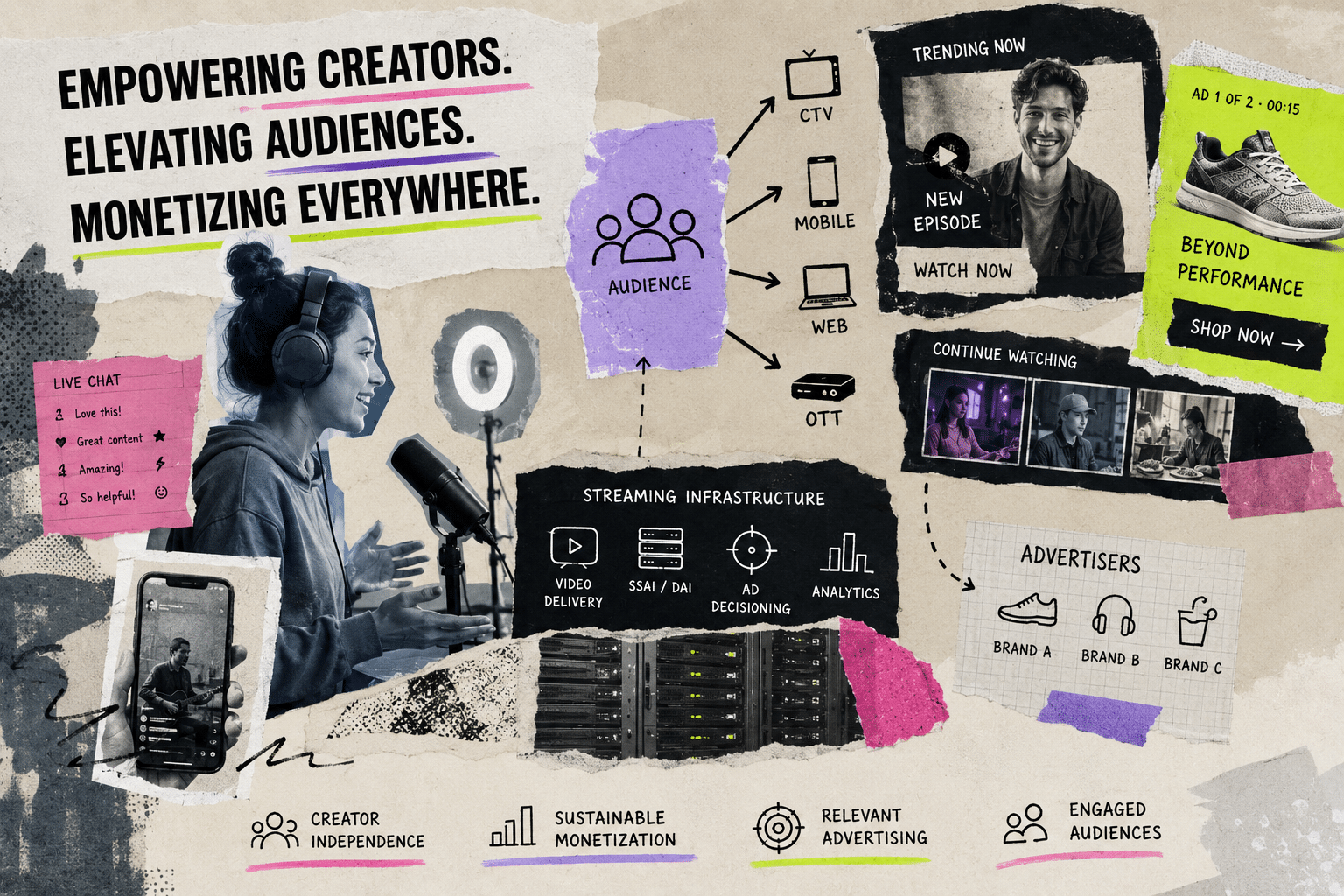
As creators diversify distribution across OTT platforms, connected TV, FAST channels, and owned applications, they require more advanced monetization infrastructure.
This is particularly important because advertising economics in streaming environments differ significantly from traditional social platforms.
Streaming monetization increasingly depends on:
- targeted advertising
- dynamic ad decisioning
- personalized ad delivery
- scalable ad insertion across devices
- analytics and performance measurement
- streaming client devices
At streaming scale, these capabilities become technically and operationally complex. Delivering personalized advertising consistently across mobile, OTT platforms, connected TVs, and live streaming environments requires real-time decisioning, low-latency delivery, and reliable ad stitching across fragmented ecosystems.
These requirements have traditionally been associated with broadcasters and large streaming platforms.
Now they are becoming creator-economy requirements as well.
Advertisers Are Driving the Convergence
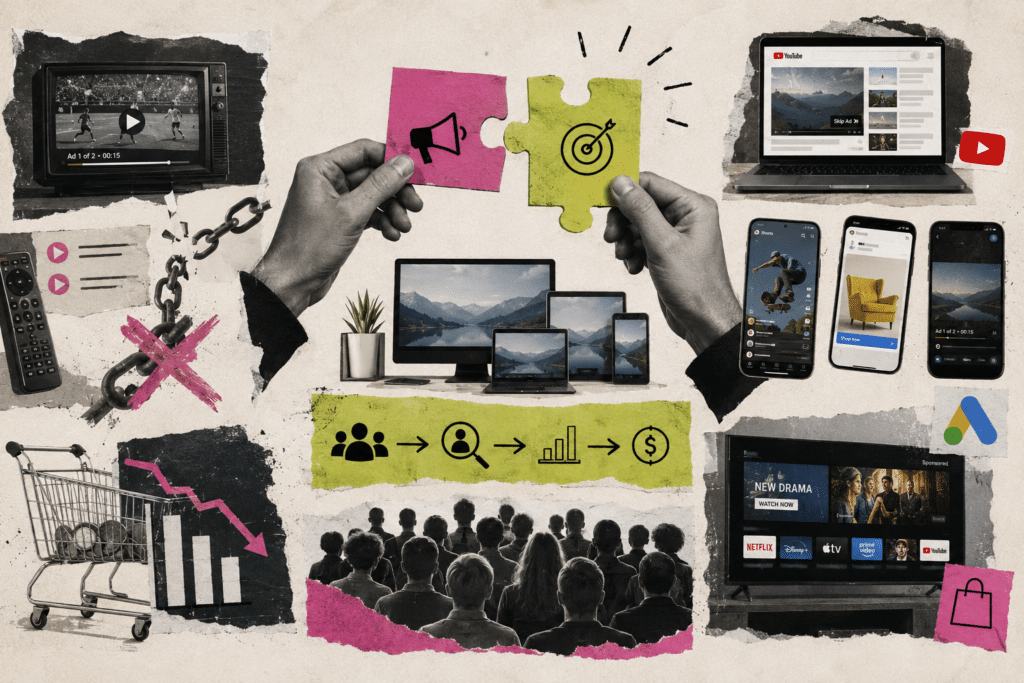
From a brand and advertiser standpoint, the need to leverage a consistent set of advertising capabilities to reach their target audiences through different distribution channels has been long standing. Unfortunately, each type of media distribution vector comes with its own technical stack and its own digital advertising capabilities. For instance, advertising on TV is pretty much limited to a binary subset of ad unit formats (basically: video pre-roll and video mid-roll). This is also where brand advertising rules.
This fragmentation is introducing impactful limitations on the ad spend. For SMBs/SMEs (small and medium size business/enterprises) for instance, assuming ad campaign budget is limited, the opportunity to spread a modest investment through a multi-platform distribution strategy is unrealistic. In this case, social media platforms often stand out as the default winners.
In parallel, if we have a closer look at the undisputed digital advertising powerhouse on the market, YouTube, we can see that advertisers can choose from a rich and wide range of ad formats [4] , at least on web and mobile devices.
Typical options such as Skippable in-stream, In-feed Non-skippable in-stream, Bumper, YouTube Shorts, YouTube Masthead give brands a very efficient and accurate toolset of creative presentation layouts. Each format responds to a very specific need in terms of visibility, campaign objective, UX, engagement.
Whether being a broadcaster, a network operator (ISP, MVPD, MSO), a studio, an aggregator, a FAST platform or an OVP, being able to offer similar types of advertising capabilities to advertisers is becoming a high priority.
This is precisely why new CTV ad formats (see IAB CTV Ad Portfolio Guidance and Signaling) can be seen as an opportunity.
Display, native, interactive, pause, shoppable, playable, clickable, actionable, are all becoming essential means to catchup.
Business wise, they enable streaming service providers to become more attractive to the demand side as they can match the expected type of inventory and sometimes business model.
Recouping ad campaign budget exclusively flowing through web, social or paid search for instance is becoming a possibility for CTV.
The question is not whether or when it will happen as it is somehow already happening.
The achievement is to come up with a strategy ensuring business continuity and ad revenue growth.
Combining brand advertising and performance advertising on streaming is an example of option matching that goal.
Monetization Is Becoming Infrastructure
As creators expand into OTT platforms, FAST channels, connected TV, and live streaming, monetization becomes far more complex than traditional platform revenue sharing.
At scale, creator-led media faces the same challenges as professional streaming services: monetizing fragmented audiences efficiently while maintaining premium viewing experiences across devices.
This is where technologies like Dynamic Ad Insertion (DAI) and Server-Side Ad Insertion (SSAI) become critical.
Ad Insertion allows advertising to be inserted dynamically in real time based on audience, device, geography, or campaign logic. Combined with SSAI, ads are stitched directly into the stream, enabling smoother playback, more consistent delivery, and better support for premium streaming environments like CTV and FAST.
These technologies also enable newer monetization models, including:
- personalized advertising
- premium CTV campaigns
- FAST channel monetization
- live event monetization
- emerging interactive ad formats
As streaming advertising evolves, monetization itself is becoming an infrastructure challenge.
The issue is no longer simply inserting ads into video streams. It is managing monetization workflows that remain scalable, measurable, and reliable during large audience peaks, especially for live streaming.
This increases the importance of adtech and streaming infrastructure partners capable of evolving alongside the creator economy.
Platforms like broadpeak.io combine video delivery, SSAI, analytics, and monetization capabilities to help streaming platforms build scalable advertising strategies across OTT and connected TV environments.
The Next Phase of the Creator Economy
The creator economy has built the audiences.
Social platforms have built highly effective advertising models.
Streaming has built scalable monetization infrastructure.
The next opportunity is to bring these worlds together.
That is, the creator economy is evolving into a new generation of media companies.
Creators are building audiences comparable to broadcasters, expanding across multiple distribution platforms, and operating increasingly sophisticated business models.
As this shift continues, scalable monetization infrastructure will become a key differentiator between creators who simply generate audiences and those capable of building sustainable media businesses.
As creators continue moving into streaming environments, advanced advertising technologies will play an increasingly important role in enabling efficient monetization at scale.
The creator economy may look different from traditional television, but its infrastructure needs are becoming increasingly similar.
As creators expand beyond social platforms, scalable monetization becomes a competitive advantage. Discover how broadpeak.io helps streaming platforms deliver advanced advertising experiences across OTT, FAST, and connected TV.
Third Party Content
[1] © Goldman Sachs 2023 | The creator economy could approach half-a-trillion dollars by 2027 | Goldman Sachs
[2] © Evan Shapiro 2026 | Media War & Peace | Evan Shapiro | Substack
[3] © MrBeast 2026 – YouTube
[4] © Google Support 2026